There’s a kind of tired that doesn’t come from working too much. It’s 8pm and the kids are finally down, and if your house is anything like mine there’s a sink of dishes you swore you’d get to and a second shift of your own life waiting in the hour before bed. This is supposed to be the soft part of the day, the part where you come down out of it, and instead, everything you didn’t finish is standing in the doorway with its hand raised. Your body is done, even though your brain still has forty tabs open.
I know that 8pm well, because I’m the one who used to sit there doomscrolling until I rolled up to bed. Or I’d suddenly remember the one email I forgot to answer and go sprinting down to the pantry where we charge our phones, just to send it before it slipped my mind again. I’m human, and none of this is a perfect science. But I’ve learned to read myself a little better now, and my clearest tell is the laptop.
When I catch myself cracking it open again after five, that’s usually a sign something’s off underneath, that I’m dodging rest instead of taking it. I spent more than a decade building an online business and reading every gauge it had, the sales, the followers, all the numbers that tell you how the work’s doing, and I got good at that. The one gauge I never learned to read was my own body, the one that had been a little bit on, all the time, for years, and it took stepping back from most of what I’d built to finally notice.
Why does my brain stay wired when my body is exhausted?
Your brain stays wired at night because you’ve probably been on call for everyone else all day, and nobody ever rang a bell to tell your body the shift is over. For most of us the day is one long act of being available, to the kids, to the inbox, to the group text, to the small not-quite-emergencies that eat a Tuesday alive. And by the time the house finally goes still, your body doesn’t automatically understand that it’s allowed to stop and go still too.
That wired feeling isn’t a character flaw, and it isn’t something that a little more discipline fixes. It’s usually a body that’s been running in everyone else’s direction since morning, and nobody’s told it yet that it can come home.
What is a nervous system reset, really?
A nervous system reset is any small, repeatable habit that tells your body the day is over and it’s safe to come down. And it’s a lot less complicated than the internet wants it to be. This idea is having a moment right now, and some of the loudest voices on it are running on empty themselves, working around the clock and never taking a day off. It’s popular for good reason. I just hope we hold onto the part underneath the trend, that learning to regulate your nervous system is deep work you keep practicing for good. You don’t graduate from it.
If you run anything online, you already track everything without deciding to, watching your daily sales and your follower count and the engagement on what you posted this morning, and you can feel within a day when something’s off. That’s the part that stops me every time.
So the question I started asking myself was pretty simple. What’s reading my body the way I read all of that? A reset isn’t one more protocol to perfect, it’s the check-in you run on yourself before the check engine light comes on and forces you to pull over on the side of the road. I’ve written before about claiming resets over routines when the day itself goes sideways, the five quiet minutes that let you start the afternoon over instead of writing the day off, and this is simply the nighttime version of that same permission.
What does a slow evening routine look like?
A slow evening routine looks like whatever pulls you out of the noise and back into your body, and mine mostly lives outside. When the kids go down, I try to leave the laptop shut. Some nights that’s the garden while the sun goes down, just me standing in the dirt for a few minutes.
Some nights it’s the sauna with Drew where neither of us says much of anything, and some nights it’s only a book and a lamp. The reading is the piece I guard the hardest, because it’s reading for fun, not to learn or get ahead, just for the pleasure of a story, and whether I get thirty pages in or three before my eyes give out, both count. The win was never the page count.
None of this routine is complicated or impressive, and that’s the reason it works, because I stopped trying to build a better evening and just let it be easy. If you want the daytime version of the same idea, I wrote about what my daytime routine looks like now, and it runs on the same principle, which is to subtract before you ever add.
How do I come back into my body after being on for everyone else?
You come back into your body by giving it one small sensory ritual that belongs only to you, before the chores get their hands on you again. The shift that changed my nights is almost embarrassingly small. Right after the girls are in bed, before I let myself get pulled toward the laundry or the counters or the thousand tiny jobs that’ll still be there in the morning, I do my skincare, and that’s it.
My therapist is the one who put me onto this, the idea of checking back in through your senses after a day of being available to everyone but yourself. So I let it be slow on purpose, noticing what I’m smelling, feeling my own hands on my own face, and letting it be the one unhurried moment in the day that belongs only to me.
It’s also what lets everything soak in before my head hits the pillow, but mostly it’s the door I walk through to get back into my own skin. Hand on heart, the clean skincare I keep on my bathroom counter is a big part of why it feels like a treat instead of a task. If you want the short list of what I reach for as the day turns into night, it lives here, curated down to the few I trust and nothing I don’t.
How do I create a screen-free evening and a bedroom that helps me wind down?
The fastest way to make your bedroom a place you wind down in is to take every screen out of it. Everyone says your bedroom should be a sanctuary, and I don’t know about you, but sanctuary isn’t the word I’d have picked for a room with a TV on the wall and two phones charging on the nightstands. That feels far less like a sanctuary and more like a docking station with a bed in it.
So the screens left, and they’ve stayed gone for years now. No TV, no phones, none of that blue light telling your brain it’s still the middle of the afternoon. Our phones charge in a box in the pantry overnight, and I know the first objection because it used to be mine, that your phone is your alarm clock. Mine was too, for a long time. A drugstore alarm clock costs about twelve dollars and it has never once handed me a devastating headline at 6am.
There’s a second reason we hold the line on it, and it has less to do with my sleep than with my girls. They’re not old enough for phones yet. But when that day comes, the rule is already the rule, and I won’t have to invent it under pressure or defend it in the middle of an argument with a teenager. Devices don’t disappear into bedrooms in this house. Your room is a space to rest. I’d much rather they grow up with that as the normal shape of a bedroom than try to install it in them at fourteen.
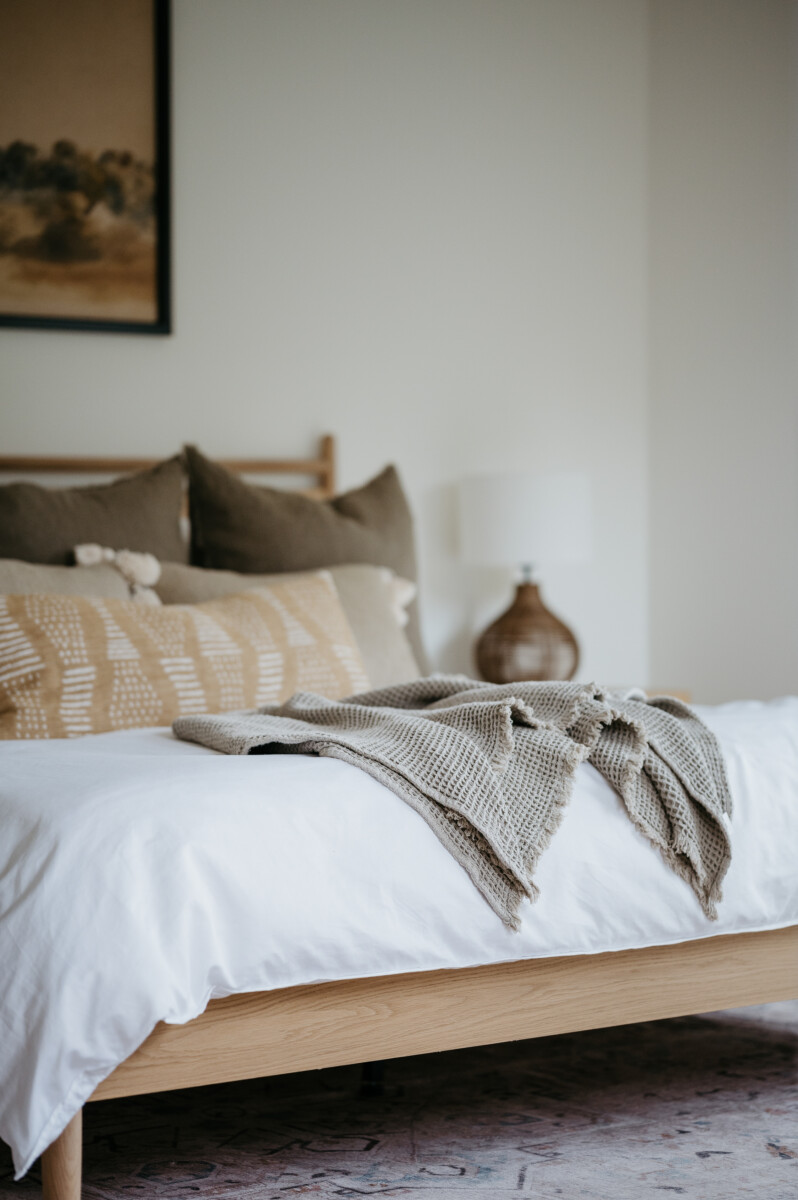
Beyond the screens, we darkened the curtains, which if you’ve ever tried to sleep through a Minnesota June you already understand, so the room goes properly dark now, the kind of dark you can sink into. There’s white noise and a humidifier going. The bedding feels good to climb into and there’s nothing on the nightstand that lights up or asks anything of me. The room has one job now, and it does it well, which is to be the place my body’s learned it’s finally allowed to stop.
What about a sleep tracker in a screen-free room?
Fair question, and I’ll be straight with you. I wear a NOWATCH, which is a wellness tracker with no screen on it at all, so it never lights up, buzzes, or gives me one more feed to check. It just picks up on my body’s signals, my stress and my rest, and I look at what it noticed later.
I’m not wearing it every night, though, and I want to be upfront about that. I stepped back from tracking everything on purpose, so it lives in a drawer most of the time. When my energy dips, or when I catch myself running low and I can’t tell why, I put it back on for a few nights and let it show me what my body already knows. Then I take it off again. It’s the gauge I check when the light on the dashboard starts to flicker, not something I stare at every day.
And if you’re the kind of person who likes to tinker and wants the full toolkit sleep routine, the mouth tape and the red light and the rest of it, I wrote that one too. This is the simple one, for the night when adding a single new step feels like the opposite of rest.
How do you start a slower evening when you have nothing left to give?
If you read all of that and felt your shoulders climb up toward your ears, believe me when I say you don’t have to build all of it tonight. Pick the one change that sounded like relief instead of homework, maybe the dark room, maybe just the laptop that stays shut, and let that be enough for now.
Rest is what lets you keep doing the work you love without it slowly hollowing you out and you were never supposed to earn it first. You’re allowed to start small, tonight, with whatever piece of this fits the life you have. You already know how to read every other gauge you keep. This is the one that reads you.
One more note before you close the tab. Whatever you pick tonight, make it the easy one. You’re not behind, and there’s no wrong way to do this. Your body’s just been waiting for you to come home to it.
Come sit with me on Substack