If you’ve been circling Automate to Accelerate for a while, reading the sales page twice and running the numbers in your head at red lights, this post is me doing the homework on your behalf before either of us enrolls.
On a flight home from Nashville, Callan Faulkner and I ended up a few rows apart, which did nothing to stop us from talking, because we texted the entire way back to Minneapolis. Callan had a literal cooler of bison burgers with her (just protein-fuel for the flight home), which I found absolutely hilarious.
I was sending her idea after idea about how we could use our brains and our work to support the Minnesota organizations we love, the ones doing meaningful work in our communities, and I was using AI right there in my seat to sketch out how each idea could work before I fired it off to her a few rows back. Somewhere on that flight it hit me how much of a kindred spirit she is, a woman who wants her work to mean something and to change the world while it’s at it.
That’s the Callan I know. I’ve always said that when people are so close to their genius, what’s common sense to them can be life-changing for other people, and watching Callan teach is that sentence happening in real time (she’ll explain something in four minutes that takes me six months to fully absorb). She’s also the person who taught me the biggest shift I’ve made in my business in years, and the founder of a program I haven’t taken yet, Automate to Accelerate (A2A), which is the one this post is about.
Callan’s AI Employee Bootcamp changed my life (my work week went from four days to two, for starters), and I learned so much from what she does inside her own company. What I struggled to do was automate it at scale. Some of what we built runs without me now, and for everything bigger I’m still the one prompting and starting new chats, so they wait for me to push them before anything happens. That gap, between knowing how this works and having it run without me, is what Automate to Accelerate is built to close, and it’s why I’m leaning toward joining this fall.
Who I am, and why you should know I’m biased
If we haven’t met, hi, I’m Jenna Kutcher. I wrote the New York Times bestseller How Are You, Really?, and I spent ten years and 968 episodes hosting The Goal Digger Podcast, helping small business owners market smarter and live softer.
Before we go any further, you should know two things. I’m an affiliate for Automate to Accelerate, so if you enroll through my link I may earn a commission, at no extra cost to you. And Callan is my friend, the one I text garden photos to, a fellow Minnesotan I spent a day with in Nashville before we caught the same plane home, and we’re working on some philanthropy here in Minnesota together.
So yes, I’m biased, and you should hear that from me first. I haven’t taken A2A yet, but I have taken Callan’s AI Employee Bootcamp as a student before I ever became an affiliate. Everything below about A2A itself comes from research: I compared the current offer against what people who took it last round have shared publicly, and when a result comes from Callan’s own marketing instead of an independent source, I’ll say so right next to it. If I join, I’ll come back and update this post from the inside.
Is Callan Faulkner’s Automate to Accelerate worth it?
For the right business, I think A2A is worth it, and I’ll be specific about who that is instead of handing you a yes. A2A makes the most sense if you’re already using AI and you’re past the beginning, you’ve hit the point where doing it all yourself stopped working, and you know you need more help or more automation to get back to your best work. It also asks a lot of you, in money and in the time it takes to learn something new, so it belongs in a season where you can give it both.
If you’re just getting started with AI, this isn’t your first step, and I’ll point you toward a better one further down.
Automate to Accelerate at a glance
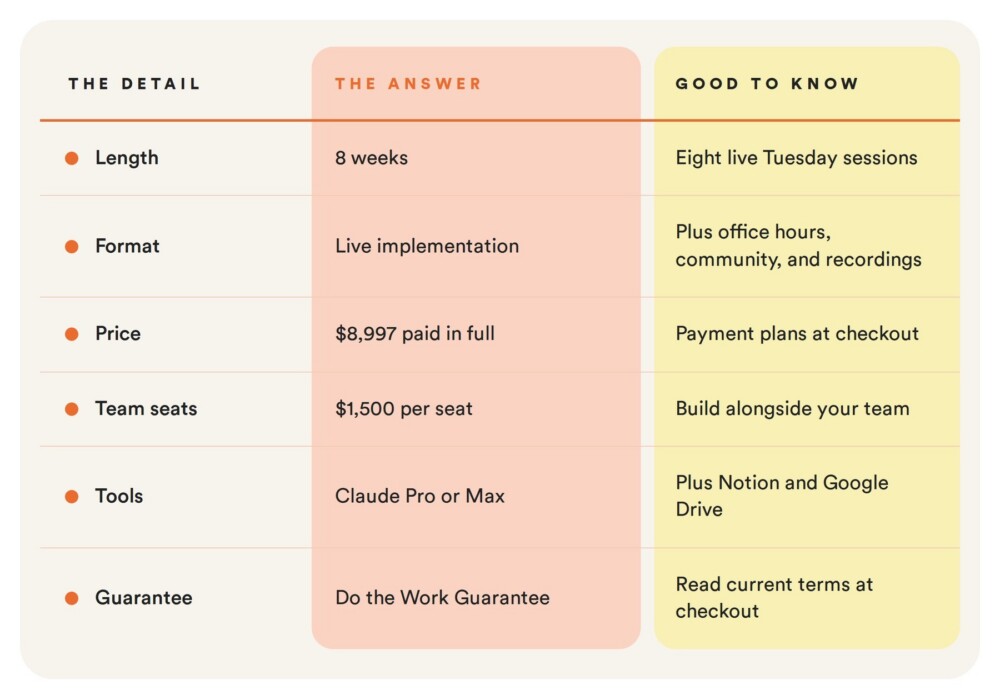
What is Automate to Accelerate?
Automate to Accelerate, usually called A2A, is Callan Faulkner’s eight-week live implementation program from The Uncommon Business, an AI training program for founders who are ready to move past experimenting. It takes the AI employee method Callan teaches and builds it into a business department by department, so the systems you create can run on a schedule or on demand instead of waiting for you to open a new chat and explain yourself again.
That last part is the reason I’m looking at it at all. I don’t need more ideas about what AI could do in my business, since I left the Bootcamp with more ideas than I had afternoons, and what I need now is for some of what I built to keep running when I close my laptop.
How is A2A different from the AI Employee Bootcamp?
The AI Employee Bootcamp is a short live training where you learn Callan’s approach and leave with your first two AI employees working. A2A is the longer implementation program that installs that approach throughout your business. I wrote in my Bootcamp review that the Bootcamp is how you find out whether this way of thinking fits your business, for roughly the price of dinner out, and A2A is what you do once you already know that it does. I know that it does, which is why I’m here.
What does Callan mean by an “AI employee”?
In Callan Faulkner’s method, an AI employee is an AI system you train to hold one job in your business. It has the context and data it needs to do that job well, a standard for what good work looks like, and the ability to do the work on demand or on a schedule. In my own business I think of these as jobs I’ve handed off, but “AI employee” is Callan’s term and the one you’ll hear inside the program.
What is the AI Business Brain?
The AI Business Brain is the shared foundation in A2A that you build the rest of your systems on top of. Think of it as the context layer that keeps your AI from starting from zero every time, so the systems you build can work from the same understanding of your business instead of asking you to re-explain it over and over.
I got a taste of this during a VIP day with Callan, when we built what she calls a second brain. They gave us second computers to run them on, which felt slightly ridiculous until I saw what mine could do. I built dashboards that update every morning so I can see my whole business in one place, a system to help fill my Instagram content cart every week, and a way to audit my Instagram performance in a single day.
What I built after the AI Employee Bootcamp
Marisa from my team took the Bootcamp with me, and afterward we built quite a lot, none of it dramatic. We organized our Marisa from my team took the Bootcamp with me, and afterward we built quite a lot, none of it dramatic. We organized our folders, we built a process for laying out my all-list emails, and we made custom Claude Skills for the work that comes around again and again.
My favorite is a single view of the business numbers I care about, the KPIs, sales, and new leads that I used to hunt down across four separate logins every Monday morning. So I’m not writing this as someone who didn’t get anything out of Callan’s teaching. I got so much out of learning the different skills and all the ways I could be using AI to replace manual tasks that I went back through the Bootcamp again this fall.
Where I’m still the one pushing
What I haven’t cracked is the running part at scale. We have systems running without me now: a reporting system that pulls our data together and helps us analyze it, my daily dashboard that helps me close loops and remember what needs my attention (including the emails I still need to answer), SEO reviewers, and a few others. But there are still plenty of bigger skills and projects where I’m the one pushing them, opening the chat, starting the project, deciding it’s time.
What I want now is for more of what we’ve already built to know when it’s time to go to work. That’s where I need the most help, and from what my friends went through last round, it’s the part A2A spends its time on. If you recognize yourself in that, with more AI knowledge than AI help, you’re the person I wrote the rest of this post for, because staying there means the work only you can do keeps waiting behind the work anyone could.
What’s inside Automate to Accelerate
Inside A2A you get live implementation sessions, office hours, recordings, and a community, organized around six departments of your business and built on top of the AI Business Brain. I haven’t sat in it yet, so this section comes from Callan’s program materials, and some details change from round to round.
Live implementation sessions
A2A centers on live build-along sessions, where you work on your systems while Callan and her team teach, plus office hours for when you hit a wall and recordings for when life happens. That format matters to me more than any curriculum list. During the Bootcamp I made my husband drive on a road trip so I could sit in the passenger seat with my laptop open and build along with Callan, because I know myself, and if I save it for later, later doesn’t come. Eight weeks of that, pointed at my own business, is something that personally really excites me.
How it automates your business processes, department by department
The program works through six core departments of a business, marketing, sales, operations, customer success, leadership, and finance, building AI systems for each on top of the AI Business Brain. I like that it goes department by department, because that’s how the work shows up in an ordinary week. When I picture my own business, marketing is where our all-list email process lives and operations is where my Monday number recap lives, and each of those started as one small build. A2A helps you do that on purpose, across your business, instead of one lucky build at a time.
The support around it
Participants get templates, a resource vault, and a community of other business owners building the same way, which is the same community a lot of the people I met in Nashville came through. I’d treat it like a good farmers market, so many beautiful things on every table, and you still only carry home what fits in your basket this week. Bonuses change from round to round, so check the checkout for this round’s.
What tools you’ll need
Callan’s current materials list Claude Pro or Max, along with Notion and Google Drive, so I’d include those subscriptions in your own math if you don’t already pay for them. The frameworks are meant to outlast any one app (which matters in AI, where the tools change roughly every three weeks), so what you’re learning is how to build the system. If the software you use today gets replaced next year, the way you think about the job it was doing comes with you.
Automate to Accelerate reviews and results from past students
People who’ve taken A2A have publicly reported getting 5 to 10 hours back a week and turning proposals around in minutes, along with a few bigger financial claims. Since I haven’t taken it myself, I went looking for them, and I’ve labeled where each result came from, because a customer saying something in public and a company quoting its customer on a sales page are different kinds of proof.
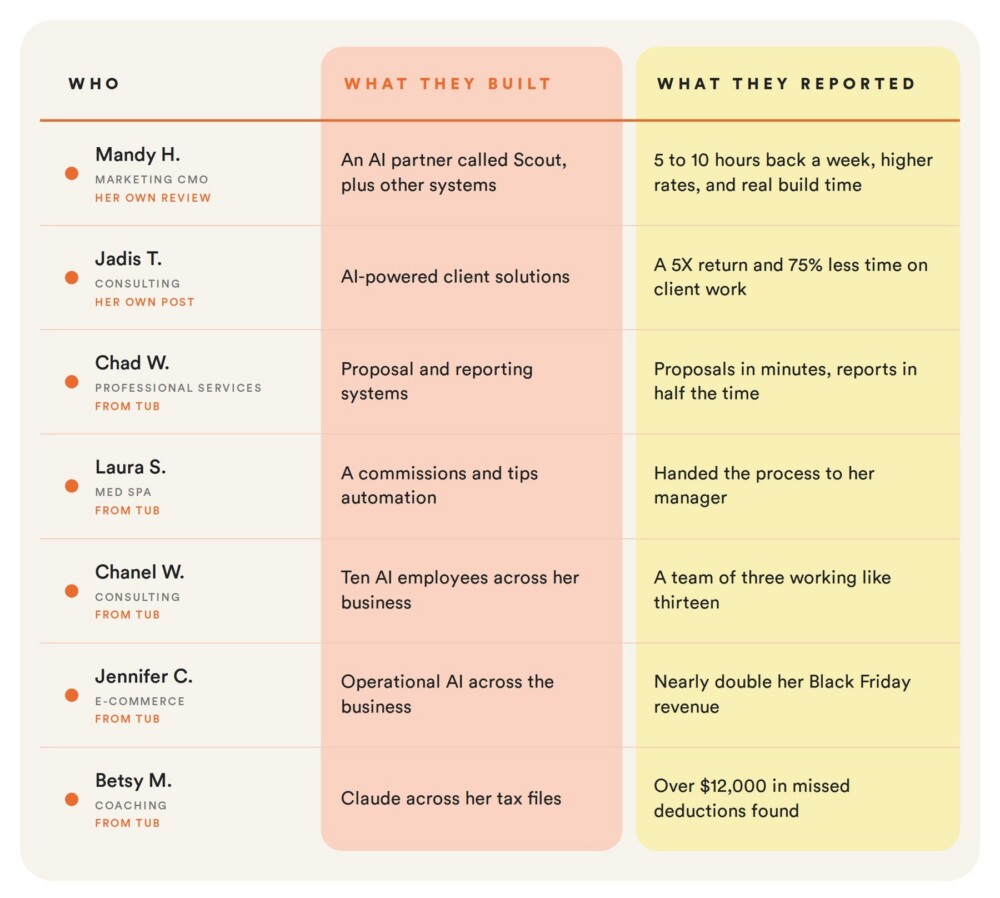
Time back came first
The results I found most useful were the ones about hours, because hours are what I’m after. Mandy Hornaday’s review is the most detailed account I found anywhere, written by someone who paid for A2A and took it, and she’s candid that one of her systems took roughly 20 to 30 hours to build before it started handing her 5 to 10 hours a week. I trust that more because she told me what it cost her to get there.
Small teams doing more
Chanel’s story is the one I’d point a small team toward, since a three-person business working more like a thirteen-person one is about capacity, and capacity is what lets a small team stay small on purpose.
The money results
Some people reported financial results, like Betsy’s missed deductions and Jennifer’s holiday revenue. These are self-reported, I haven’t audited them, and I haven’t seen data showing they’re typical, so read them as what’s possible for someone who did the work.
Answering the objections before you ask them
These are the questions I’d be asking if I were reading this cold, and a few of them I’ve been asking myself.
“That’s a lot of money.”
It is, and I’m not going to pretend otherwise. The way I’d think about it is in hours instead of dollars. If an hour of your time is worth $100 to your business, A2A has to hand you back about 90 hours to pay for itself, and at $50 an hour it’s closer to 180. The best-documented result I found, 5 to 10 hours a week from a single system, would clear that bar within a few months (and it’s one person’s result, so hold it loosely). If you can’t name where those hours would come from in your own week, that’s a sign to wait.
“I already took the Bootcamp. Isn’t that enough?”
For some people it will be, and that’s a good outcome. The Bootcamp gave me the way of thinking and my first builds, and it didn’t give me systems that run without me, because three sessions was never going to do that. If your builds are running fine on their own, you may not need A2A. If you’re where I am, with builds that still wait on you to start them, this is the next step.
“I run a small business. Is this too big for me?”
Size matters less than repetition. The people reporting results ranged from a fractional CMO working on her own to a three-person consulting team to businesses with full staffs. What they seem to share is work that comes back every week, like proposals, reports, and client deliverables, and that’s the work A2A builds around.
“I don’t have time for this.”
This is the one I’d take most seriously. A2A is an implementation program, and building takes time before it gives time back. Mandy put 20 to 30 hours into one system before it paid her back weekly, so if your calendar is already full to the edges, look at what you’d move to make room before you enroll.
“Do I need to be technical?”
You need to be willing to learn, and I say that as someone who has used these tools to ask whether chickens can eat corn cobs. Callan teaches from the job outward, which is what made the vocabulary finally land for me in the Bootcamp, and if you’re unsure about the technical side, The Uncommon Business team can walk you through it before you enroll.
“Can’t I learn this for free on YouTube?”
You can learn a lot for free, and I did, and what I couldn’t do on my own was get what I learned to run without me. I’ve come to believe that part is much easier with someone walking you through your own business in real time.
“Is A2A legit?”
The Uncommon Business is a real operating company using the same approach it teaches, with a public site at theuncommonbusiness.co. During one stretch of its growth, 36 humans and 150+ AI employees is what it took to scale TUB from $4.2 million to $20.9 million in under two years. Those figures describe that growth period and aren’t a current headcount, and the team has continued hiring since. The most useful outside evidence I found is Mandy Hornaday’s independent review, which includes both her results and her frustrations.
“Isn’t AI bad for the environment?”
It has a real footprint, and I wrote more about how I use it with that in mind in my Bootcamp review. The short version is that a system trained well once needs far fewer rounds of prompting later.
How much does Automate to Accelerate cost?
Callan Faulkner’s Automate to Accelerate is $8,997 paid in full for this round, with payment plans available (the checkout shows the current installment amounts). Team seats are $1,500 each, and the program comes with a Do the Work Guarantee tied to completing the program and attempting the builds, so read the current terms at checkout before you enroll.
You’ll also want Claude Pro or Max, Notion, and Google Drive, so check what you already pay for before adding them up.
If you’re deciding between going alone and bringing someone, I’d look hard at the team seat. My one tip from the Bootcamp was to bring someone, because Marisa and I could converse about where the ideas fit and start assigning ourselves work while it was still fresh, and one of my best friends made the same call when she brought her whole team into A2A.
Who I think Automate to Accelerate is for
You’re already using AI, and you’re past the beginning. You’ll probably recognize yourself in at least one of these:
- You can’t white-knuckle it alone anymore. You’ve built things and learned things, and you’re still the engine behind every one of them.
- You know you need more help or more automation to get back into your best work.
- This is a season where you can invest, both the money and the time it takes to learn something new and build with it.
- You can name the jobs that come back to you every week, because those are the jobs A2A builds around.
Who I’d tell to wait
If you’re just getting started with AI, start somewhere smaller, like my Bootcamp review or the prompts I use, and come back when the back-and-forth with AI starts to feel like the bottleneck. If you’re clear you don’t want to use AI at all, I respect that, and this program isn’t for you. And if this isn’t a season where you can give it the time, the money, and the room to learn something new, wait for one that is, because A2A will ask for all of it.
If your revenue isn’t steady yet, get there first, because A2A is built to multiply a business that already works. If your processes only live in your head, spend a few weeks writing down what you do. When, since that list becomes the raw material for everything you’ll build.
If your next eight weeks already belong to a launch, a move, or a busy season, give that your full attention and catch the next round. The simplest check I know is this one: if you can’t say what done looks like for a job, that job needs a system before it needs AI, and A2A will go much further for you once you can.
What I’d want you to know about the limits
In my Bootcamp review I said I didn’t have a complaint to hand you, and I meant it. This time the research handed me a few, and you should walk in knowing them instead of finding them in week three.
It’s broad by design. A2A serves founders, operators, marketers, and attorneys in the same room, which means great cross-industry ideas and also examples that won’t map neatly onto your business. The upside is one I felt in the Bootcamp, when an example from a totally different world (Callan’s own dad was one of mine) turned “good for her” into “how could that work for me?” The cost is that you’re the one doing the translating.
The possibilities can pile up. A big community and a steady stream of new use cases only help if you’re willing to choose what not to build, and Mandy was candid that she didn’t have the bandwidth to mine all of it. If I join, I’m walking in with the two or three jobs I most want off my plate, and letting everything else be inspiration for later.
Building takes time before it gives time back. Every system I have running without me had to be built first, on a day that was already full. I think about it the way I think about planting dahlia tubers, since nothing blooms the day they go in the ground, and then it blooms all season. Plan for the up-front hours, because that’s the trade you’re making.
The details change from round to round. While researching this, I found older A2A pages listing a 10-week version at $7,997, which isn’t the program being offered now. Trust the live checkout over anything you find indexed (including this post, if it’s been a while since I updated it).
How to decide if A2A is right for you
If you’re still on the fence, I get it. I’ve bought the top tier of programs out of pure aspiration and then never opened them, so I know how it feels to worry this could be one more of those. You don’t need to decide today, and you don’t need to decide alone. The simplest way I know to get off the fence is the same way I’m deciding for myself:
- Name the jobs that keep coming back to you. Write down what you did this week that you also did last week, like the reports, the follow-ups, or the posts you format by hand. If you can say what done looks like for a few of them, you have something to build. If you can’t yet, that’s your first project, and it doesn’t cost a thing.
- Check the current offer. Look at the live checkout for this round’s price, payment plans, schedule, and guarantee, since those change between cohorts. Give yourself a quiet hour with it before enrollment closes instead of deciding in the last ten minutes, because a decision made in a rush rarely feels like yours.
- Pick your door. If your list is long and this is a season you can invest in, enroll. If it’s short or fuzzy, start with the Bootcamp and come back when it isn’t. Either door is a yes to getting your time back, just at a different pace.
And if you stay on the fence, nothing breaks. The same jobs will just keep coming back to you every Monday, waiting for you to start them.
My honest verdict on Callan Faulkner’s Program Automate to Accelerate
I love learning, and the Bootcamp changed how I work so much that I can’t quite imagine what a full program built around my own business would do, which is the most honest reason I can give you for why I’m leaning toward joining.
The hours I’ve already gotten back turned into an entire dahlia garden, a farm stand, the decision to homeschool my kids, splitting our time between different places, a kitten, and a seat on the board of our local soup kitchen. That’s what a few systems running without me made room for, and I’d love to see what more of them could make room for.
Your version won’t look like mine, and it doesn’t need to. Maybe it’s a slower Friday, or the creative work that keeps getting pushed to next month. What would yours be?
If you can name yours, the jobs that keep coming back to you and the systems you built that still can’t run without you, A2A is worth a close look, and I’d love to compare notes from the inside. If you can’t name it yet, start smaller, and you’ll know when it’s time.
Not ready for any of it yet? The six prompts I used to get things off my plate are free, and they’re a good place to feel what handing work to AI is like before you spend anything.
Frequently asked questions about Automate to Accelerate
Is Callan Faulkner’s Automate to Accelerate worth it?
Callan Faulkner’s Automate to Accelerate is worth a close look for established business owners who already use AI and need it running without them. Participants report hours back each week, faster proposals, and more capacity on small teams, though results depend on how much you build. I haven’t taken A2A yet. I took Callan’s Bootcamp as a student, and I’m an affiliate.
How much does Automate to Accelerate cost?
Automate to Accelerate costs $8,997 paid in full for the current round, with payment plans available and team seats at $1,500 each. Installment amounts have changed between cohorts, so the live checkout is the place to confirm them. If the price stops you, run the hours math first: at $100 an hour, A2A needs to hand you back about 90 hours to pay for itself.
How long is Automate to Accelerate?
It is an eight-week live implementation program, with eight Tuesday build sessions plus office hours, a community, and recordings. Older pages online still list different lengths from earlier cohorts, so trust The Uncommon Business site for the current schedule. Recordings mean a missed Tuesday won’t sink you, though in the Bootcamp I found the live sessions were where the building happened.
What do you build in A2A?
In Automate to Accelerate, you build an AI Business Brain for your company, then AI systems for individual jobs across six departments: marketing, sales, operations, customer success, leadership, and finance. Think proposals, reporting, and client work that run on a schedule or on demand. The goal is systems that start without you, so you stop being the one who has to open the chat.
What is the difference between the AI Employee Bootcamp and A2A?
Both come from Callan Faulkner’s The Uncommon Business. The AI Employee Bootcamp is a short live training where you learn the method and leave with your first two AI employees working. Automate to Accelerate is the eight-week program that builds that method into your whole business. I think of the Bootcamp as finding out if this way of working fits, and A2A as building it in.
What is an AI employee?
In Callan Faulkner’s method, an AI employee is an AI system trained to hold one specific job in your business. It has a defined role, the context it needs, a standard for good work, and the ability to run on demand or on a schedule. In my own business I call these jobs I’ve handed off, because that’s what they feel like.
What is an AI architect?
An AI architect is the person who designs how AI fits into a business: which jobs AI holds, what each role needs to know, how work moves between roles, and where a human reviews it. In a small business, that’s usually the owner, and Callan Faulkner’s A2A is built around owners doing that design work themselves. You don’t need to code for it. You need to know how your business runs, and nobody knows that better than you.
Does A2A have payment plans?
Yes, The Uncommon Business offers payment plans for Automate to Accelerate. The installment options have changed between cohorts, so check the live checkout for this round’s amounts before you decide. If you’re weighing a plan against paying in full, compare the total you’d pay each way, since the plans have added up to more than the paid-in-full price in past rounds.
Can I bring my team to A2A?
Yes, Automate to Accelerate offers team seats at $1,500 each for the current round. Many owners in past cohorts brought their teams so they could build side by side, and one of my best friends took A2A with her whole team. I brought someone from my team to the Bootcamp, and having a person to brain bump with about where the ideas fit is what made it stick.
Do I need to know how to code for A2A?
Callan Faulkner teaches Automate to Accelerate starting from the job you want handled, using everyday tools like Claude, Notion, and Google Drive. What it asks for is a willingness to learn and time to build, and The Uncommon Business team can answer specific technical questions before you enroll. I’m not an engineer, and the Bootcamp still made complete sense to me.
Is A2A good for solopreneurs?
Automate to Accelerate can work for solopreneurs. Participants have ranged from solo operators like fractional marketers to small teams and larger companies. Size matters less than repetition, so the better question is whether your business has work that comes back every week, like proposals, reports, or client deliverables. If it does, you already have something to build.
Is A2A worth it if I already use ChatGPT or Claude every day?
Automate to Accelerate can make especially good sense if you use ChatGPT or Claude every day but you’re still the one initiating the work. Daily use often means you’ve gotten fast at prompting while your systems still wait on you to start them. That was exactly my situation after the Bootcamp, and it’s the gap A2A is designed to close.
What software do I need for A2A?
Automate to Accelerate materials list Claude Pro or Max, Notion, and Google Drive, so budget for those subscriptions if you don’t already have them. The frameworks are taught to transfer across tools, which matters because AI software changes fast. What you’re learning is how to build a system, and that stays useful after any one app is replaced.
Does Automate to Accelerate have a guarantee?
Yes, Automate to Accelerate comes with a Do the Work Guarantee from The Uncommon Business, tied to completing the program and attempting the builds. The terms are specific and can change between rounds, so read them at checkout before you enroll. I like that it’s built around doing the work, since that’s the part that makes any of this pay off.
Are A2A student results typical?
No published data shows what a typical Automate to Accelerate result is. The results available, like hours saved each week and faster proposals, are self-reported by participants or published by The Uncommon Business. They depend on how much each person builds, so treat them as examples of what building can lead to.
When does A2A open again?
The hands-on 8-week experience opens in cohorts through The Uncommon Business, and the current round is open for enrollment from October 6 to October 16, 2026. If enrollment has closed by the time you read this, join the waitlist on The Uncommon Business site. In the meantime, the Bootcamp or my free prompts are a good way to start building now.
What eight weeks could change
Picture a Monday in late November. Nothing special on the calendar. You open your laptop and the weekly numbers are already summarized, the follow-up emails from last week’s calls are drafted in your voice and waiting for a yes, and the research you’d been meaning to get to for a month is sitting in a folder, sorted. You didn’t ask anybody for any of it that morning, because each one of those jobs already has an owner.
I can’t promise you that Monday, and I’d be wary of anyone who does. What I can tell you is that the distance between the business where you’re the bottleneck and the business where you’re the architect is shorter than it looks from inside it, and that I’ve watched it shrink in my own. If this is your season, eight weeks with Callan is a serious way to close it. If it isn’t, that’s a good answer too, and the work that defines you will still be here waiting.