One of the easiest sentences to say (and the hardest to live out) is: focus on what you can control. You’ve probably heard that a dozen times, and maybe it even felt dismissive the last time someone said it to you.
Because here’s the thing: sometimes life is hard and out of our hands, like health issues, financial struggles, a tough season with your kids, business roadblocks. Not everything is fixable in the moment, and a quick mindset reset isn’t going to magically erase real problems. But the way we relate to those circumstances? That’s where your power lives.
You don’t need toxic positivity; you need tools and grounding reminders that shift your mindset without gaslighting your reality. Let’s talk about what it really looks like to reset your thoughts when life feels stuck.
RELATED: Scarcity, Abundance, and the Mindset Work I Avoided
Step 1: Identify the Thoughts That Are Holding You Back
Before we can shift anything, we have to name it. And for me, that usually starts with an ugly cry in the car or a journal page that looks like a therapy session. I’ve learned that I carry sneaky thoughts like, “If I slow down, I’ll lose everything I’ve built,” or “Rest is for people who don’t want it as badly.” These aren’t truths; they’re fear in disguise.
When I notice myself spiraling in comparison or impatience, I start asking gentler questions. I’ll take five minutes while the kids are playing or after a workday and just check in: What’s really going on underneath this feeling?
Some questions you can start with are:
-
- Do you feel frustrated with aspects of your life?
-
- In what areas of your life do you feel the most inspired and free?
-
- What stresses you out or makes you anxious?
-
- How do you feel about your future?
-
- How do you feel about your relationships?
-
- How do you feel about yourself?
-
- Do you ever think “I want to do/be/achieve ____, but I never will because _____.”?
Sometimes just putting a name to it, like “I feel behind,” or “I’m scared I’ll disappoint people”, brings so much clarity.
You can’t rewire what you haven’t revealed.
RELATED: 5 Expert-Backed Mindset Shifts That Will Change the Way You Work, Rest, and Dream
Step 2: Recognize Your Mindset Loops
For me, it was the hustle loop. The one that kicks in when something feels out of my control, when fear creeps in or I start feeling not-enough-ness buzzing in the background. Suddenly I’m thinking about rearranging the furniture at 10 p.m. or rewriting a launch plan I’d already decided was “good enough,” because this part of me still believes more effort equals more worth, that if I just do more, I’ll finally feel safe, valuable, accomplished… enough.
But here’s the truth: most mindset loops like this aren’t about the present moment. They’re protective patterns, coping strategies that once helped us survive. At some point, your brain linked effort or control or perfectionism with safety, and honestly, it probably was helpful at the time; that loop helped you get through something. The problem is you’re not in that season anymore, but the loop doesn’t know that, so it keeps playing.
I’ve learned that when I notice one of my loops kicking in, I have to acknowledge it without shame. I’ll literally say out loud: “Oh hey, hustle loop. I see you. I know you’re trying to keep me safe, but I’m okay now. I’ve got this.” It might sound a little silly, but naming the loop and gently talking back to it helps me step out of reaction mode and back into choice. It reminds me that I’m the one in charge now, not the old pattern, not the fear.
One phrase I come back to again and again when I need a reset is: “It’s okay to let this be easy.” Even just whispering that to myself helps something soften inside, inviting peace back into the moment. I want to gently challenge the belief that I need to hustle or prove anything in order to be okay.
So if you’re noticing the same thoughts or reactions show up again and again, pause and get curious. What’s the loop? When did you learn it? Is it actually serving you now? You don’t have to judge it. Just notice it, name it, and remind yourself that you have permission to choose differently now.
RELATED: When Science Meets Spirituality: How to Trust Your Gut and Grow into Who You’re Meant to Be
Step 3: Create Space for Stillness
Stillness used to scare me. Silence felt like a summons for every anxious thought I had worked so hard to outrun. So I stayed busy, filling every gap with noise, motion, and tasks, not because I had to, but because I didn’t know how to be still without feeling like I was falling behind.
But over time, through burnout, breakdowns, and soul-searching, I began to unlearn what hustle culture had taught me. I started to understand that rest isn’t a reward you earn after doing “enough.” Rest is resistance, and stillness is sacred. Choosing to slow down, to actually be present in your life, to savor the fleeting moments you only get to live once? That’s revolutionary, especially in a world that tells you to keep grinding.
For me, rest became more than just a break; it became a boundary. Rest is a declaration that this version of success would not require me to abandon myself. I didn’t want to build a business that needed me to be glued to a screen or clinging to control in order to thrive. I wanted to live my life, like really live it. That meant rewriting the story I’d been handed and defining success in a way that made space for joy, peace, and presence.
These days, stillness looks simple: folding laundry with no podcast playing, sitting in the car with the music off, watching the sky turn pink while my house is still asleep. It’s quiet, yes, but not empty. It’s full of me coming home to myself.
If rest makes you feel anxious or unproductive, take that as a sign: not that you’re doing something wrong, but that you’re finally listening. In that stillness, your own voice starts to get louder again, and that’s the voice that matters most. You can’t pour from an empty cup, and you certainly can’t create a meaningful, lasting impact if you’re constantly running on fumes. Stillness is not just a pause; it’s a power move.
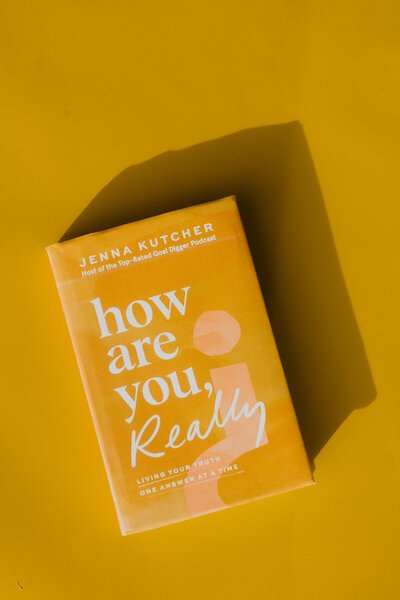
It’s one of the core reasons I wrote my book,How Are You, Really?: to invite you back to yourself, your truth, your story. When we slow down long enough to check in, to get honest, to breathe, that’s where real clarity lives. So if you’re tired, if you’re stretched thin, if you’ve been waiting for permission to rest, this is it.
Step 4: Write a Letter to Your Fear
To take a note from the incomparable Elizabeth Gilbert, you can write a letter to your fear. On these letters, she says, “Often, I think I know what I’m afraid of, but when my fear is given a chance to actually speak, I’m surprised at what the real issue is. …my fear is not (contrary to how it often feels) bottomless.
Fear and anxiety can feel like they have infinite depths, like they are afraid of everything, but usually they are just afraid of 2 or 3 very specific things, once you look closely.” From there, she writes a letter back to her fear thanking it for protecting her, and then “respectfully explains your new plan.”
The first time I wrote a letter from my fear, it said something I didn’t expect. It wasn’t afraid I’d fail; it was afraid I’d outgrow what felt safe. 😮💨 And the second I saw it in writing, I felt compassion. I didn’t want to destroy my fear, I wanted to reassure it.
So now, when I feel afraid, I give that voice some room and let it speak. Then, like Elizabeth Gilbert suggests, I write back with grace: “I see you. You’ve protected me. But I’m choosing something new.” Your fear isn’t the enemy; it’s just the narrator. You’re still the author.
Step 5: Anchor Yourself in What You Can Control
Here’s what anchoring looks like in practice: shutting the laptop early to go for a walk and let the sun hit your face, leaving the dishes in the sink so you can curl up and giggle with your kids without watching the clock, standing barefoot on the porch while the coffee brews. These micro-moments of presence are how you come back to yourself, and they are gloriously non-renewable.
I used to believe I had to fix everything before I could feel peace. If the launch numbers weren’t where I wanted them to be, or the inbox was overflowing, or a text had gone unanswered, my nervous system would go into overdrive trying to fix it all. I thought if I could just get everything in order, then I could finally exhale. But peace doesn’t live on the other side of perfect outcomes; it lives in the present moment, in the practice of choosing where your attention goes.
These days, I find that peace by returning to what I can control: my breath, my body, my choices in this one moment. You don’t need to control everything to feel grounded. You just need to reconnect with yourself. So if today, your next best step is to breathe, to drink some water, to take a 10-minute walk or send one brave message or simply rest your hand over your heart and say, “I’m okay”? That counts. This is how we reclaim peace: not by chasing perfection, but by choosing presence.
RELATED: Break Free from the All-or-Nothing Mindset Today
When You Don’t Have Time for a Full Mindset Reset
I used to believe that if I couldn’t do a full-blown morning routine or stick to a set structure every day, I was somehow failing. Spoiler: I’m not that girl, and maybe you aren’t either. Especially after learning I have ADHD, it all made sense: the resistance to rigid routines, the struggle to start, the chaos of back-to-back roles (hello, mom life and entrepreneur brain colliding on a Tuesday morning). I used to feel broken because I couldn’t follow the “successful people” schedules, but now I’ve learned to honor what actually works for me.
What changed everything wasn’t some 10-step routine; it was the permission to reset whenever I needed to, to find mini pockets in my day where I could pause before I pivot. Maybe it’s not a perfect sunrise meditation, but it’s standing barefoot on the porch while the coffee brews. Maybe it’s not journaling for 20 minutes, but it’s laying on my PEMF mat or playing one song on the piano before I head into work mode. It’s drinking water, taking a cold plunge, or simply saying: “I’m doing my best.”
You don’t need more rules or more guilt. You need more grace. Resetting isn’t about doing more; it’s about returning to yourself in the gaps, in the transitions, in the real life moments where your nervous system is whispering, “Hey, can we slow down for just a second?” You don’t have to wait for the weekend or the morning to take care of yourself; you just need a moment, any moment, to breathe, listen, and begin again.
RELATED: Screw Routines, Try This Instead
Shifting Your Mindset When Life Feels Unchangeable
Here’s what I want you to walk away with: you don’t have to wait for your life to feel perfect to start feeling peaceful, and you don’t need everything to make sense to choose a new story. You can still be in a hard season and make small, daily shifts that change the way you walk through it.
Mindset work isn’t about pretending everything is fine. It’s about building inner safety, so you can face what’s not fine with more grace, clarity, and strength. You get to lead your mind, build your belief, and be free even when things feel uncertain. So no matter what’s going on around you, know this: you’re not stuck, you’re growing, and you’re not doing it alone.
A Simple Way to Recenter When Life Feels Out of Control